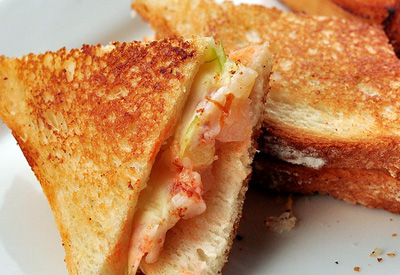
"Whether you’re an avid Grilled Cheese lover or want to whip up something totally indulgent (and worth it) with one of summer’s finest foods—lobster- you'll want to make this amazing recipe courtesy of Iron Chef Marc Forgione. Forgione’s unique twist on the classic grilled cheese makes the perfect mouth-watering meal."
Lobster Grilled Cheese courtesy of Marc Forgione and T-fal
Ingredients:
For the Chili Lobster:
2 cups Lobster Stock (If you can’t find Lobster Stock, get seafood stock, which should be available at Whole Foods or Fox & Obels)
4 (1 1/2 pound) lobsters, claws removed
1/4 cup Sriracha
2 tablespoons low-sodium soy sauce
Juice of 2 limes
6 ounces (12 tablespoons) unsalted butter, divided
4 tablespoons canola oil
Kosher salt
Freshly ground black pepper
2 tablespoons chopped tarragon
8 slices of fontina cheese
4 slices Pullman Loaf or other high-quality thick sliced white bread (1” thick)
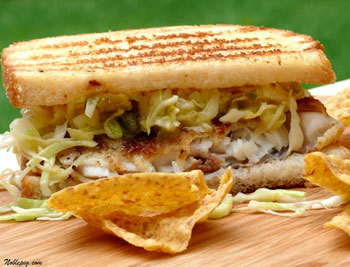 I love a good fish sandwich and it has been a while since I've had one. I came across this recipe using tilapia, a firm, forgiving and inexpensive fish. I loved the idea of piling coleslaw over the fish and using pulverized almonds as part of the crust, making it somewhat reminiscent of sole almondine.
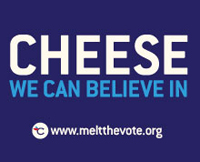 The 2008 National Grilled Cheese Month Campaign kicks off at Clementine on Tuesday, April 1st with an exciting and diverse field of grilled cheese candidates. Grilled Cheese Primaries will be held at Clementine during the first 4 weeks of April. Each week, five different sandwiches will campaign on the menu and when you order a sandwich, your vote will determine which sandwiches earn a spot on the ballot for Super Cheeseday(s), April 28-30. Your votes on Super Cheeseday(s) will determine the winner, our
next Commander in Cheese, the Highest Sandwich in the Land.
The 2008 National Grilled Cheese Month Campaign kicks off at Clementine on Tuesday, April 1st with an exciting and diverse field of grilled cheese candidates. Grilled Cheese Primaries will be held at Clementine during the first 4 weeks of April. Each week, five different sandwiches will campaign on the menu and when you order a sandwich, your vote will determine which sandwiches earn a spot on the ballot for Super Cheeseday(s), April 28-30. Your votes on Super Cheeseday(s) will determine the winner, our
next Commander in Cheese, the Highest Sandwich in the Land.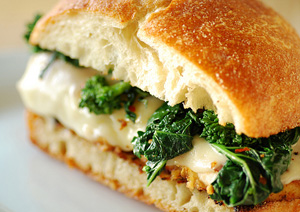 How did chicken sandwiches become so popular in the U.S.? Supply and demand. The emergence of large scale chicken processing companies such as Perdue and Tyson in the 1920’s and 1930’s respectively, helped propel chicken’s popularity in America. With such easy availability, chicken prices decreased, consumption increased, and chicken became a steady part of the American diet.
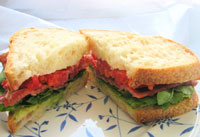 I don't know if Mae West ever ate a Cobb Salad, but I bet she would
have loved it. After all, she was the one who said "too much of a good
thing is wonderful". A Cobb Salad begins with a bed of Romaine lettuce,
think of it as your basic crunchy blank canvas.
Resting on the greens are strips of toppings – luscious chunks of
avocado, juicy fresh tomato, crumbles of rich blue cheese, hard boiled
eggs and chunks of chicken breast. Frankly I've always found the
chicken to be superfluous, but maybe that's just me.
I don't know if Mae West ever ate a Cobb Salad, but I bet she would
have loved it. After all, she was the one who said "too much of a good
thing is wonderful". A Cobb Salad begins with a bed of Romaine lettuce,
think of it as your basic crunchy blank canvas.
Resting on the greens are strips of toppings – luscious chunks of
avocado, juicy fresh tomato, crumbles of rich blue cheese, hard boiled
eggs and chunks of chicken breast. Frankly I've always found the
chicken to be superfluous, but maybe that's just me.