 During the season of Lent, an herbaceous perennial sends up its hearty bells of florets on sturdy stems – bridging the gap between winter and spring.
As with the season of Lent itself – a wintry season of contemplation, spiritual focus, and petition - these symbols of new life out of the deathlike state of winter are emblems of the newness of spring, rebirth, and rejuvenation.
Helleborus is the genus name for Lenten Roses to which these perennials are often referred as Hellebores. Hellebores range from garnet to ruby, lilac to lavender, and to the purest white. Once the flowers begin to fade, the petals become chartreuse and lime green, lasting for months on their stems and for days in arrangements. Some of the flowers are the simplest, five petal blossoms you’ll ever see, while others are compound arrays of florets with freckles or dark nectaries complemented by bright sepals.
Leathery leaves, pretty and green, make for a delightful texture in the garden. The dark green of the Christmas Rose, Helleborus niger, is quite stunning around Christmas time and into January. The pure white flowers dangling above the glossy greenery are beautiful sentiments for the Christmas Holidays. From there, cultivars and cross species of Helleborus orientalis will begin to emerge and bloom through the winter and especially during Lent…quite an appropriate name, eh? From bloom time to color to texture, I’m sure you’ll be able to find a Hellebore to suit your garden’s fancy.

 Many vegetables take the spring spotlight: asparagus, fresh peas, and fava beans, among others. And then there a few humbler ones that fall to the wayside, like small bright-red radishes.
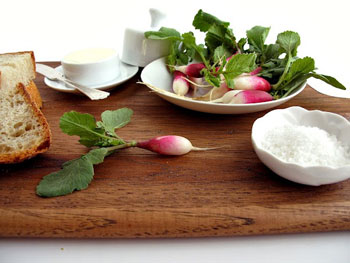 This really isn't a recipe—it doesn't even involve cooking or assembly. It's just a few simple ingredients brought together in a perfect way: radishes, butter, and salt. Most people don't give radishes a second thought mainly because they don't eat them. As I've shown in recipes before and will show this week, radishes can be made into many different dishes with ones that are even cooked. But the absolute best way to eat them is with just a little salt and butter.
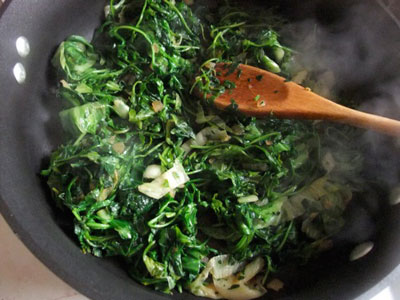 Bags of organic arugula at the store always tempt me. "Buy me!" they say, "Eat salad for a week, it'll be great!" Of course after three or four days the bag is half full and the contents start to look rather wilted and sad. Then comes regret. Why did I buy that bag in the first place? Recently I found the solution to the problem of wilting greens, a problem that I'm guessing may also be yours.
 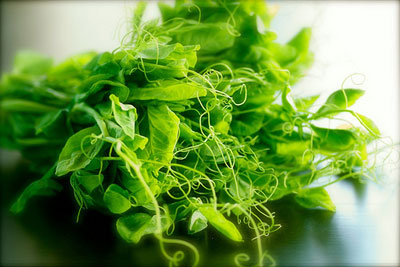 A couple of weeks ago I experienced a revelation: I tasted my first pea shoot.